
From Party Death to Murderer
Hallowe'en PartyThis flow traces how an apparently inexplicable death at a children’s party becomes a focused investigation into a killer whose earlier crimes have returned to threaten new witnesses.
increasing Bearing strength in each event
 decreasing
Bearing strength in each eventdecreasingThe Party’s False Calm
The Party’s False Calm
A Managed Celebration
At Apple Trees, Rowena Drake directs a carefully scheduled children’s party, moving guests through games, supper, and the final Snapdragon. The smooth arrangements create an atmosphere in which a private act of violence can hide inside ordinary bustle.
The Unnoticed Absence
Joyce Reynolds’s boast that she once saw a murder is dismissed as another performance by a girl known for exaggeration. After the festivities, the adults discover that she has not gone home; in the library, they find her drowned in the apple-bobbing bucket. The party’s apparent success abruptly becomes a crime scene.
A Witness’s Old Claim
A Witness’s Old Claim
The Story Behind the Shock
Ariadne Oliver goes to Hercule Poirot because Joyce had declared during the party preparations that she had once witnessed a murder. The claim seemed boastful at the time, but Joyce’s death makes it newly urgent: someone might have killed her to prevent a buried crime from becoming known.
A Motive Takes Shape
Poirot recognizes that the killer would probably have heard the claim earlier that day and acted quickly. Joyce may not have identified the murderer in her supposed earlier sighting; the danger could instead be that she had revived someone’s fear of exposure. The investigation thus turns from an isolated attack toward a connection between present violence and a past secret.
Old Cases Enter the Inquiry
Old Cases Enter the Inquiry
Competing Explanations
Poirot consults Superintendent Spence and hears the local expectation that a disturbed intruder or adolescent might have killed Joyce without a personal motive. The familiar explanation competes with Poirot’s suspicion that the murder was a deliberate attempt to silence a witness.
The Past as a Lead
Spence supplies a list of violent deaths and suspicious events, including Janet White’s unsolved murder and the death of Lesley Ferrier. Poirot compares how a child might have witnessed each event and later understood its significance. The inquiry expands in time, but each old case must earn its place through evidence rather than resemblance alone.
Water and the Broken Vase
Water and the Broken Vase
An Unexplained Reaction
Elizabeth Whittaker recalls seeing Rowena Drake drop a heavy vase of flowers near the end of the Snapdragon. The fall appeared to be an accident, but Whittaker remembers Drake starting as if something had startled her while she looked toward the library door.
A Physical Constraint
Poirot sees that a person who forced a struggling child’s head into a full bucket would probably become wet. The broken vase could have supplied an innocent explanation for wet clothes, while the library door links the apparent mishap to the hidden killing. The clue does not yet prove who acted, but it gives the inquiry a concrete test that psychological speculation lacked.
The Pattern Becomes Proof
The Pattern Becomes Proof
A Second Silencing
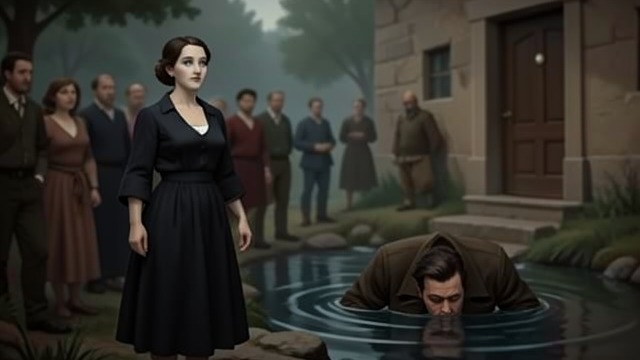
Leopold Reynolds is found drowned in a stream after apparently using his knowledge to demand money. His death confirms that someone fears disclosure enough to kill again, and Rowena Drake finally tells Poirot that she saw Leopold emerge from the library after Joyce’s death.
The Hidden Witness Identified
Poirot connects the false vase accident, the children’s secret, and the old crime witnessed by Miranda Butler. Joyce had repeated Miranda’s story as her own, triggering the attack without knowing why it mattered. When the original witness is brought to safety and identifies Rowena Drake and Michael Garfield, a chain of inference becomes an evidentiary accusation.
The afternoon and evening of the Hallowe’en party
The night after the party, in London
The first days of Poirot’s investigation in Woodleigh Common
During Poirot’s interviews, before the second child’s death
After Leopold Reynolds is killed and the investigation reaches its climax
